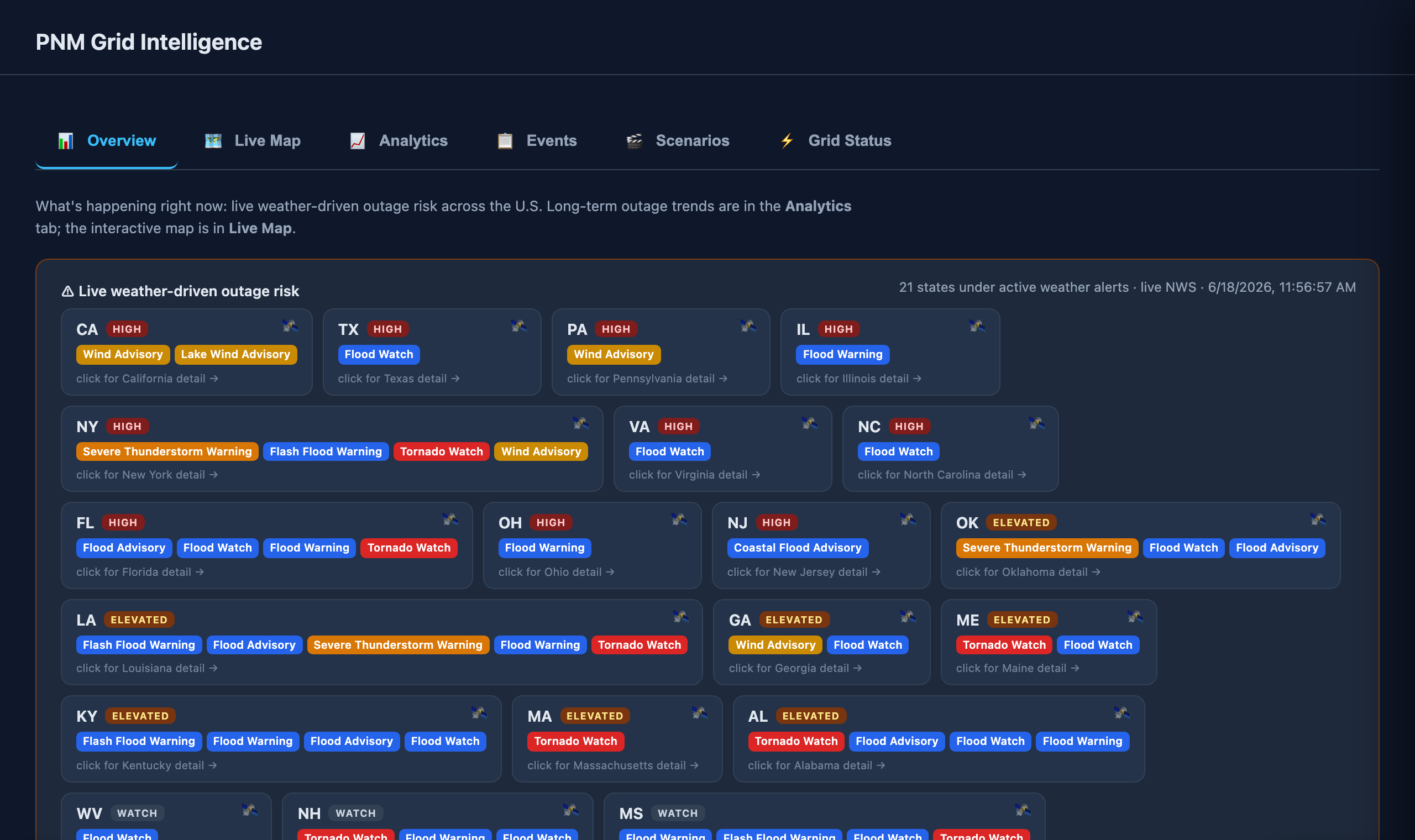
1 · The big picture
This dashboard maps U.S. power outages and live grid conditions on real public data (2000–today). Six tabs across the top are the navigation: Overview (live weather-risk + an AI brief), Live Map (the interactive map hub), Analytics (the outage filters, trend charts, and the full event table), Scenarios (replay real grid events), Grid Status (live PNM demand & peak monitor), and Vegetation (the wildfire-fuel encroachment scanner). The cause/state/year filters live on the Analytics tab.
2 · 🧠 Situation brief
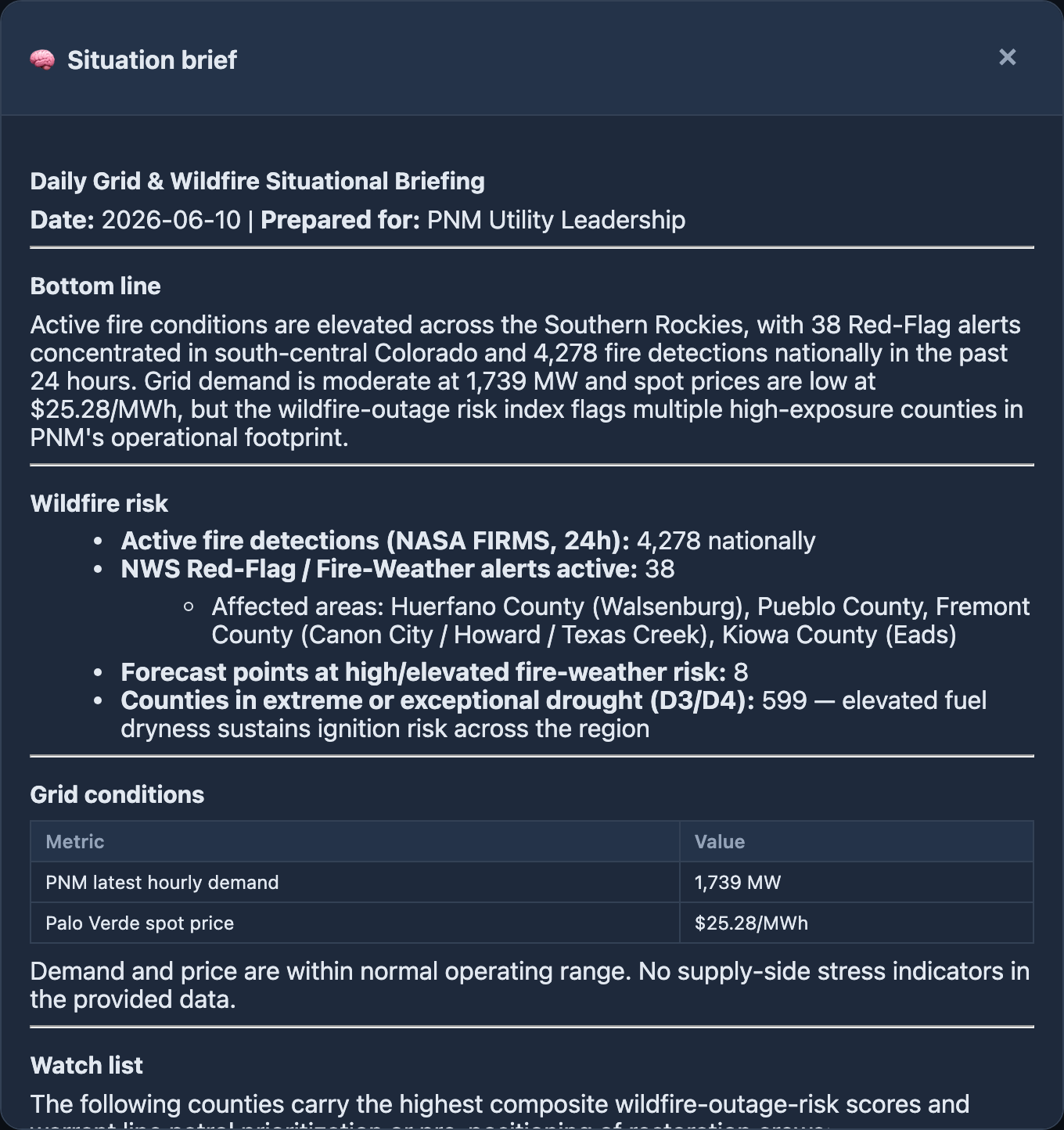
The Overview tab opens with an AI situation brief — it compiles the current numbers (active fires, red-flag alerts, drought, grid demand and price, top-risk counties) into a one-page, plain-language leadership briefing, led by a PNM watch — New Mexico section that zeroes in on PNM's own territory and the risks worth acting on. It's cached and regenerated at most once every 12 h, and every brief is saved — hit 🕘 History to re-read past briefs. The fastest read on "what's the grid picture right now."
3 · ✦ AI grid analyst
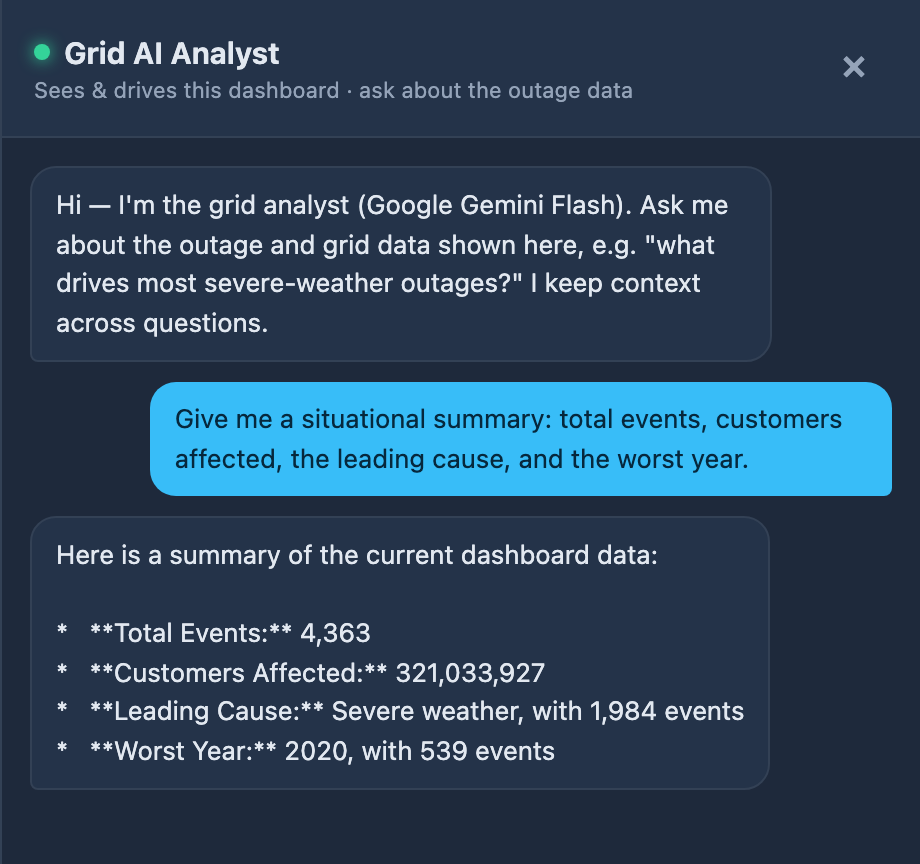
The ✦ AI analyst (bottom-right) isn't a generic chatbot — it's wired into the dashboard's live, filtered data (Google Gemini Flash). It answers from the real numbers on screen and respects your active filters: narrow to New Mexico, severe weather, or a year range, then ask, and it scopes the answer to exactly that subset. It holds context across a conversation, so you can drill in.
Put it to work — analyze, rank, compare, explain:
› "Which states have the worst equipment-failure outages — and what's the pattern?"
› "What's the trend in weather-driven outages from 2000 to 2016?"
› "Summarize New Mexico's outage history for a leadership briefing."
› "Compare winter-storm vs. wildfire outage impact across the Southwest."
› "Given current conditions, what should PNM be watching for today?"
The same engine threads through the whole app: it writes the daily situation brief (Overview), the after-action reviews on the scenario replays, and auto-drafts SAIDI/SAIFI reliability reports (⚙ Layers → Reliability report). It's grounded and honest — it answers from the data, won't invent a number, and flags real data gaps. (Requires the AI backend running with a Gemini key.)
4 · Map layers (the ⚙ Layers button)
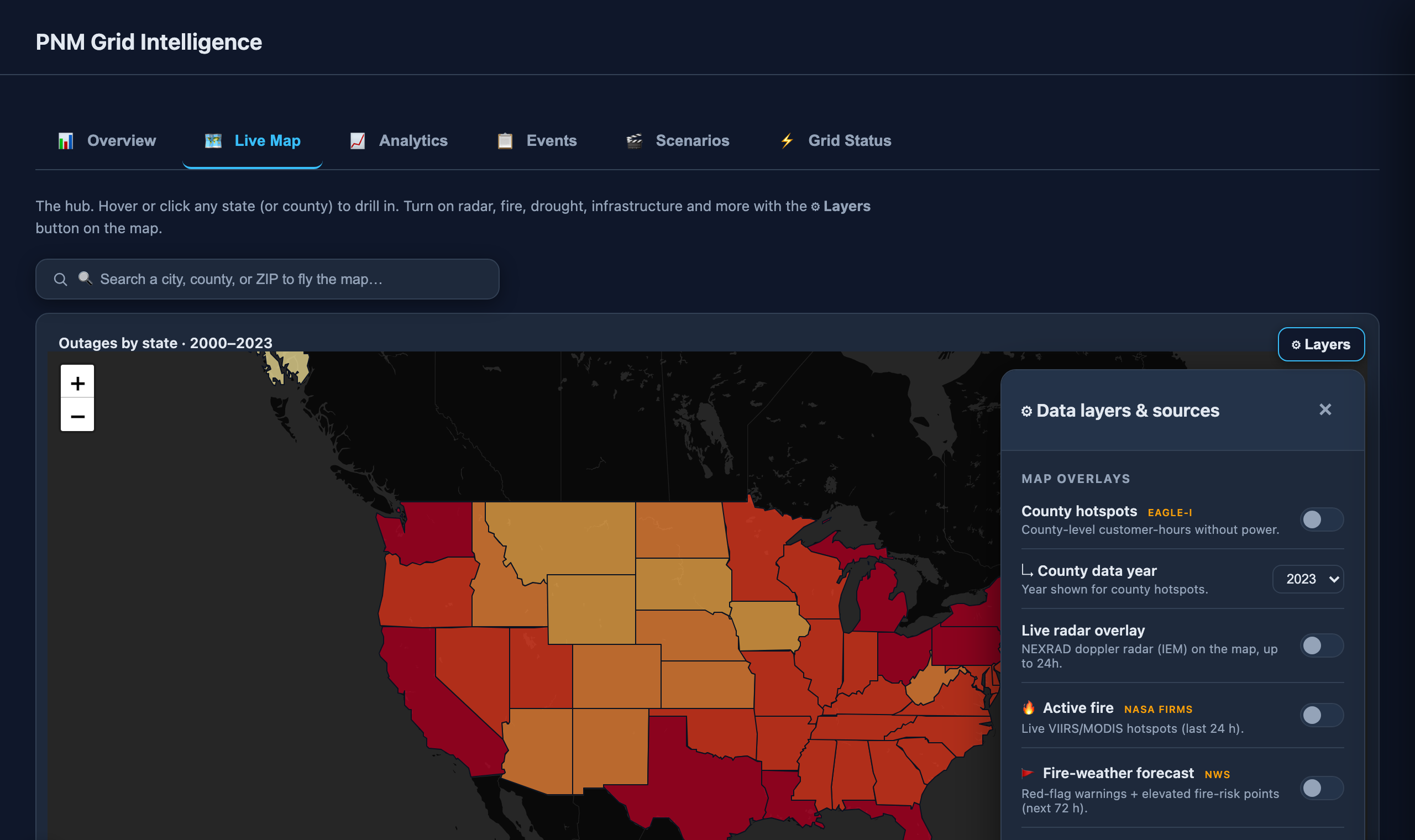
On the Live Map tab, the ⚙ Layers button sits on the map (top-right). Click it for an on-map control panel: state/county color-by metrics, live radar, active fire, fire-weather, winter alerts, drought, social vulnerability, and grid infrastructure — they all draw on the map. The search box above the map flies you to any city, county, or ZIP — pick a county and it switches into county view automatically. Press Esc to close it.
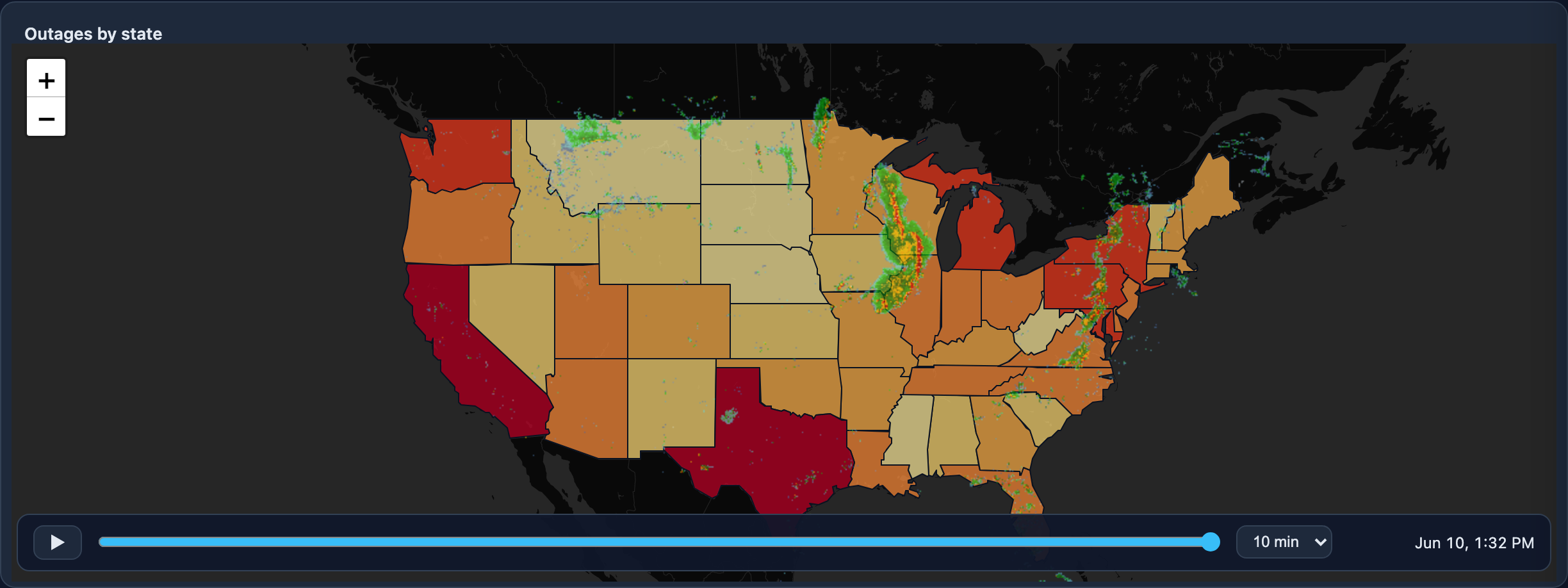
5 · Live weather radar
Turn on Live radar overlay and a control bar appears on the map. Hit ▶ to animate real NEXRAD radar, or drag the timeline to any moment. The step selector covers 10 min up to a full 24-hour day. Radar draws on top of the outage colors.
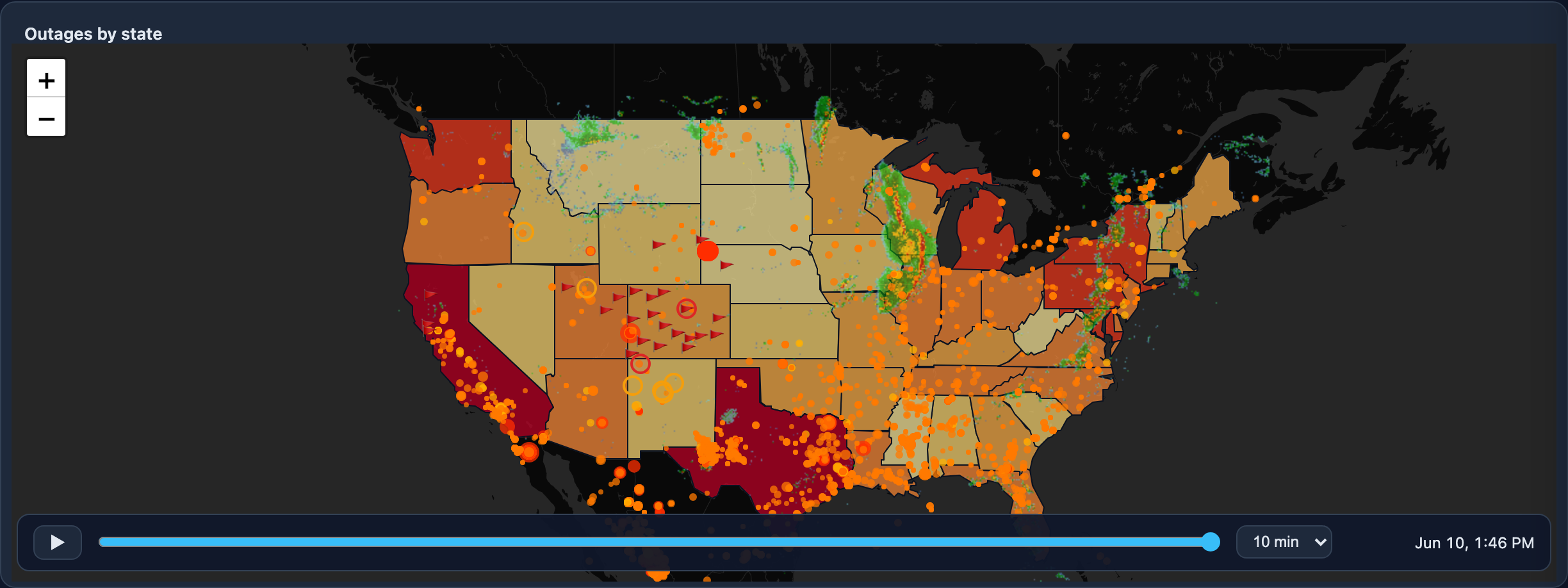
6 · Live weather & fire
Toggle Active fire (NASA FIRMS hotspots), Fire-weather forecast (NWS red-flag warnings + elevated-risk points), and radar together to see what's threatening the grid right now. Hover any fire for its heat output and confidence.
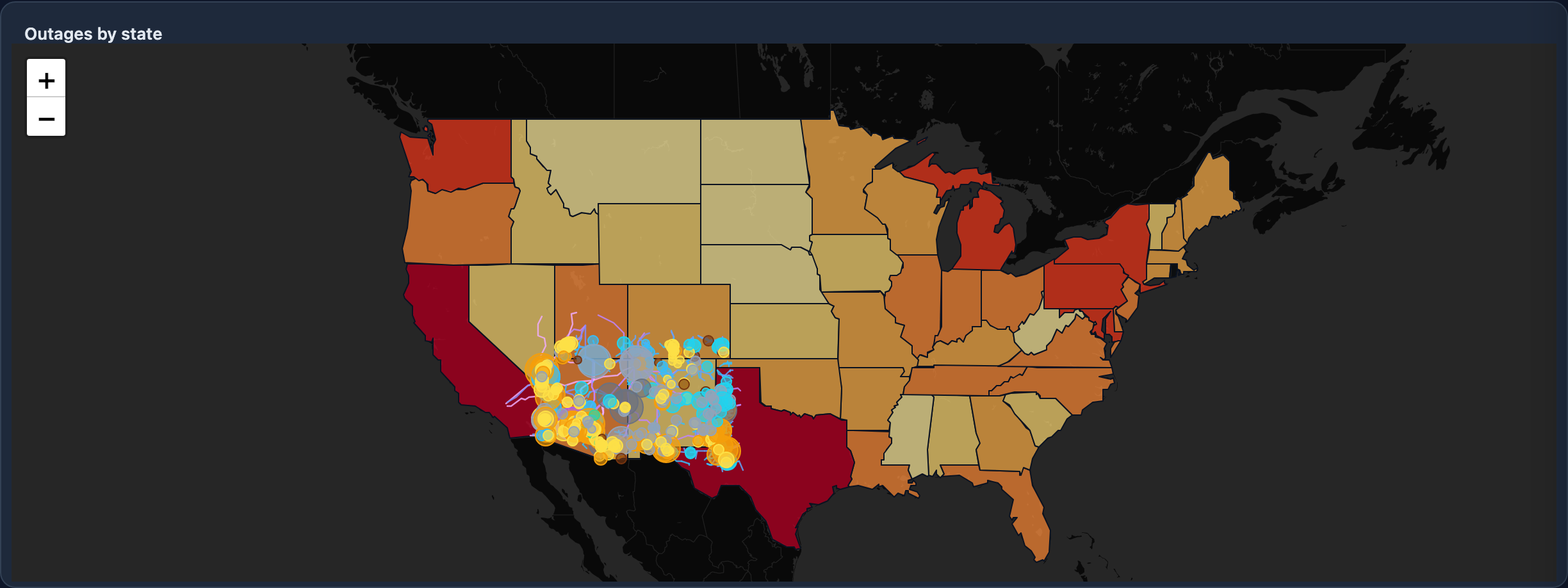
7 · Grid infrastructure
Under Infrastructure, overlay real federal (HIFLD) data: transmission lines colored by voltage, substations, and power plants sized by capacity and colored by fuel — so you see where the grid actually runs relative to the hazards.
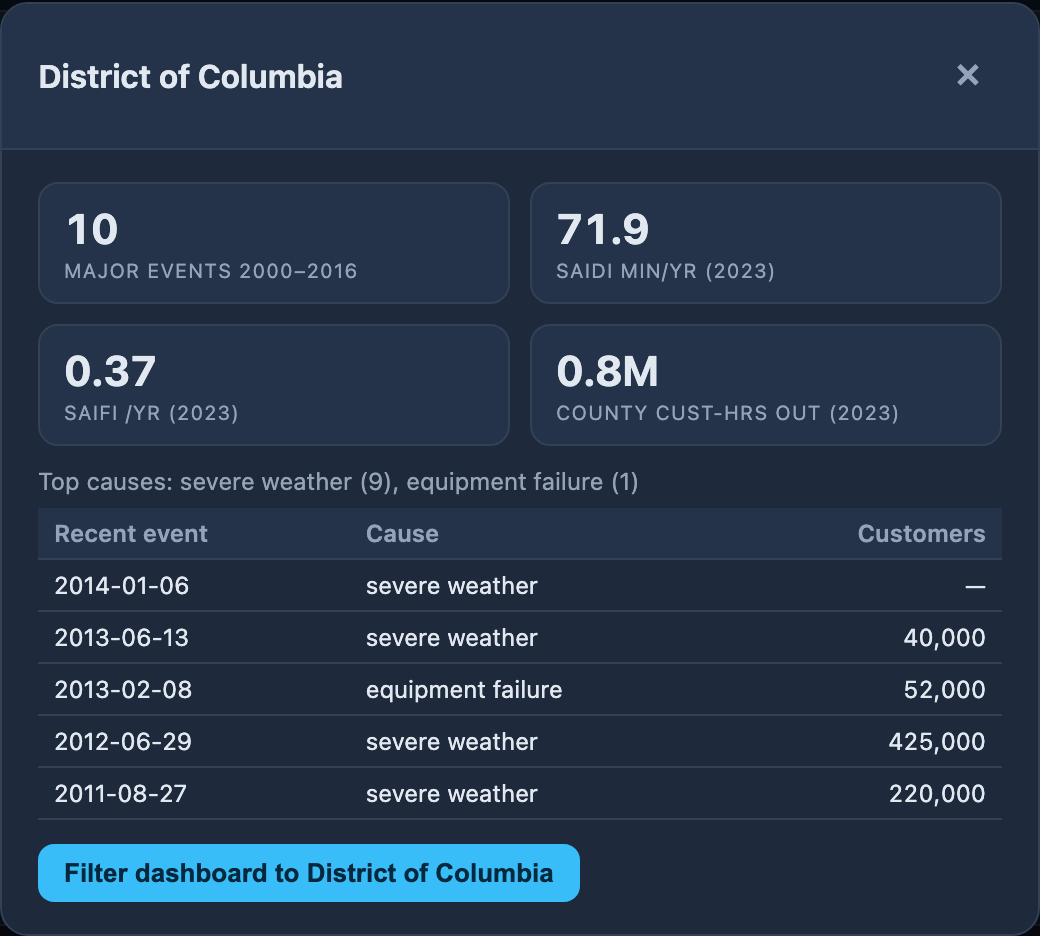
8 · Click for detail
Click any state (or any county in county view) to open a detail card: major-event count, reliability (SAIDI/SAIFI), county outage-hours, top causes, and recent events — plus a button to filter the whole dashboard to that state.
9 · ⚡ Grid Status tab
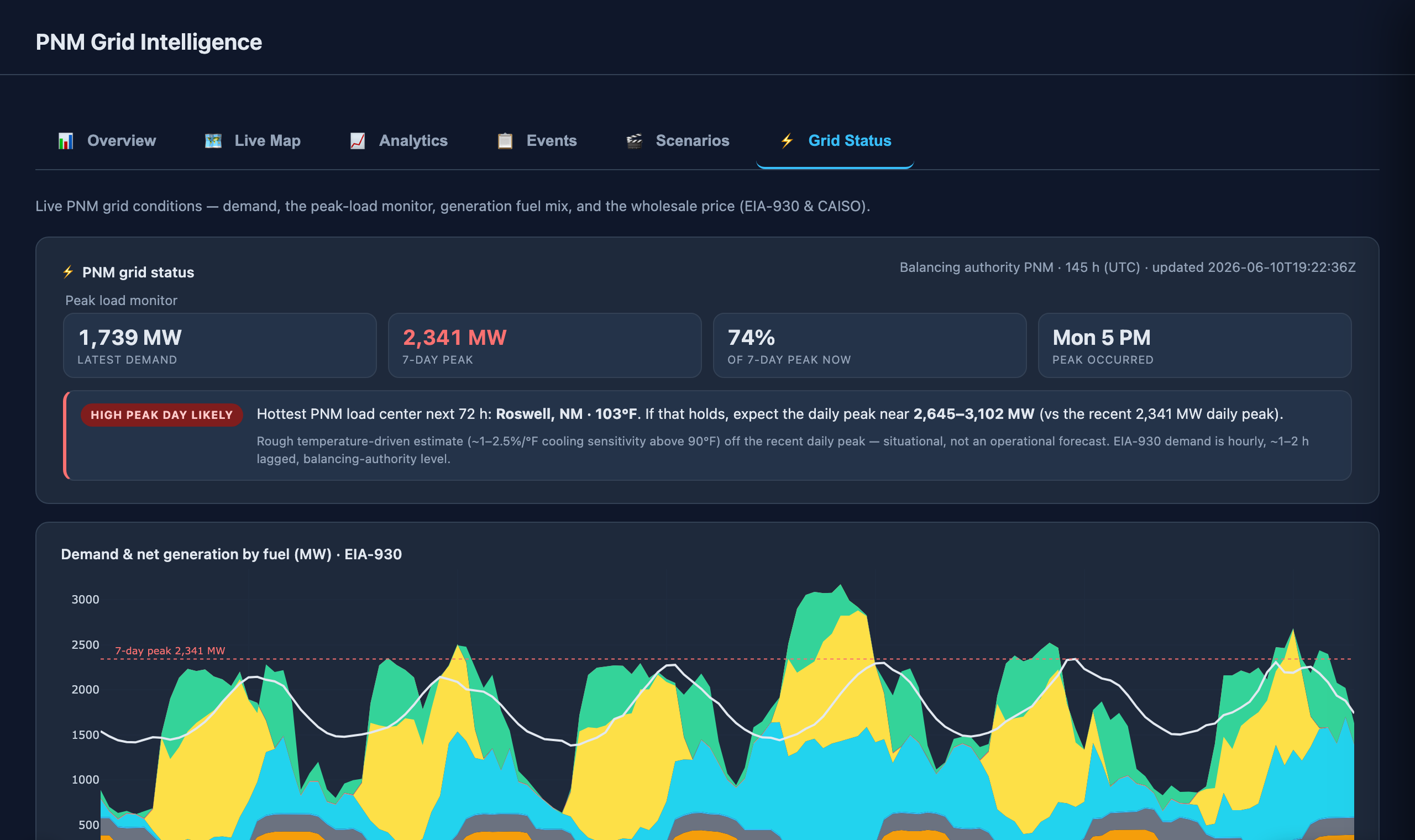
The Grid Status tab opens the peak-load monitor: latest demand, the 7-day peak (and when it hit), and how close demand is to that peak right now — all from EIA-930. Below it, a temperature-driven outlook reads the hottest NWS forecast high across PNM's load centers and flags the next peak day (Normal / Elevated / High) with a rough MW estimate. Then the live demand + generation fuel mix and the Palo Verde wholesale price (CAISO). The outlook is a clearly-labelled heuristic, not an operational forecast.
10 · 🌲 Vegetation scanner
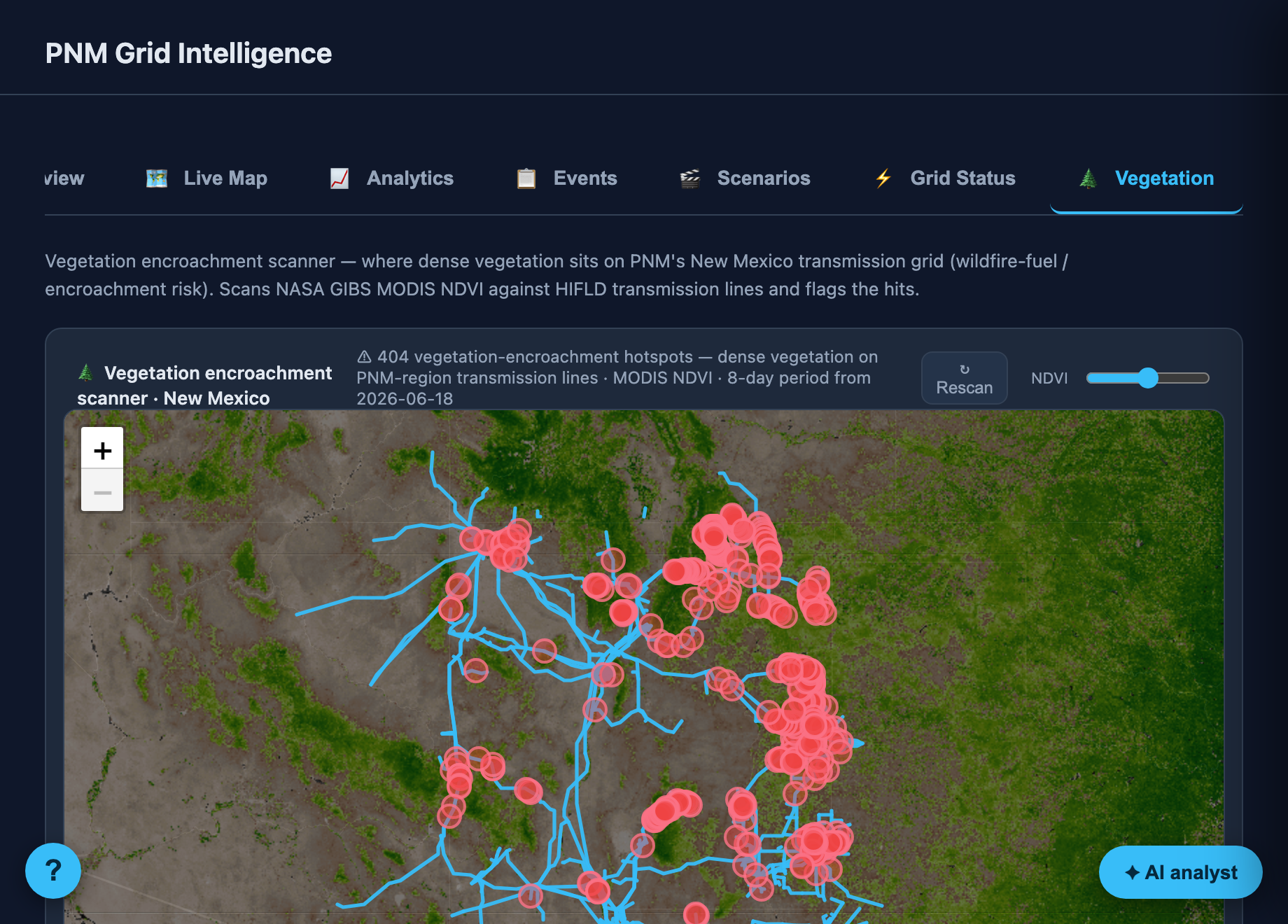
The 🌲 Vegetation tab scans New Mexico's transmission grid against NASA GIBS MODIS NDVI and highlights the spots where dense vegetation sits on a line (red) — wildfire-fuel / encroachment risk. Hit Rescan to re-run; the NDVI backdrop is dimmable.
11 · ★ Risk index — what it all unlocks
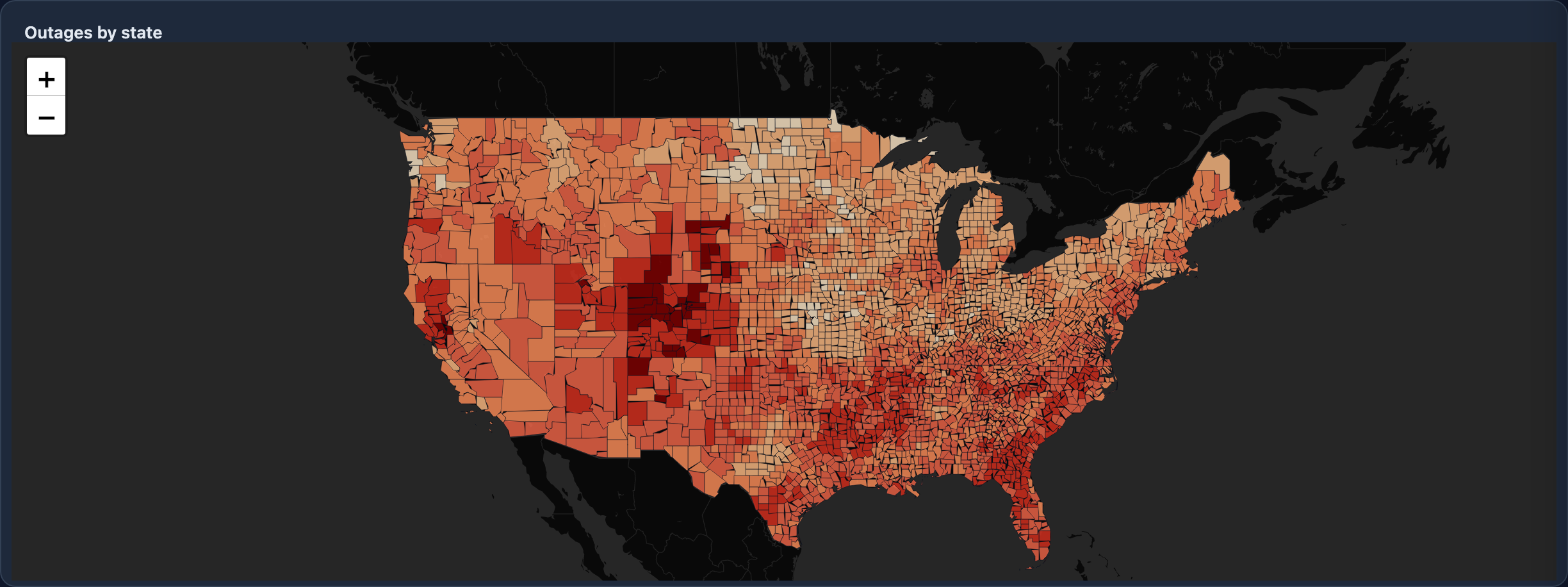
The payoff of every layer: this fuses drought, fire-weather, active fire, outage history & social vulnerability into one 0–100 county risk score (⚙ Layers → "Wildfire-outage risk index"). Hover any county for its score — the "where should we worry today" view that powers PSPS-style decisions.